For a Practice based on the teaching that there is no separate self, we spend a lot of time asking “Who is here?”
To answer the question “Who is here” requires a change in perspective as it isn’t possible to be whoever I am in the moment and also see who that is. This movement to a more expanded awareness is termed dis-identification.
The first myth that gets busted in an Awareness Practice is the assumption that “I” is a fixed, monolithic entity. Observation results in the discovery that Walt Whitman expressed as “I am large, I contain multitudes.”
It is a relief to understand that “I” is a composite of parts because it helps make sense of why we can seldom be the way we want to, ought to, should be. The aspect that wants to eat chocolate every day is not the one who wants to lose weight!
We can become fascinated by the layers of personality that are uncovered through the question “Who is here?” Our gallery of “Who I Am” can be vivid and detailed. But the focus on the person(s) isn’t the point of a practice of dis-identification. The point is the discovery that “I am large.”
Repeatedly stepping back from “Who is here” leads to a spaciousness that can see, accept, include and embrace all aspects of “me.” This larger context appears as a Presence that has no problem with or judgment about what is within the field of observation. It is often described as unconditionally accepting witnessing. As this context becomes more familiar, it, a living-seeing absence of identification, replaces the “me” “I” believe “myself” to be. This is perhaps what Dogen meant by:
To study the Buddha Way is to study the self; to study the self is to forget the self; to forget the self is to be actualized by myriad things.
That “I” tend to get stuck in watching rather than transcending identification simply means that whoever is here isn’t consciously aware of “who is here.” Of course, “forgetting to ask” is not an accident. We can see Screwtape’s signature all over the process of cementing the identification with “what I am not.”
In a passage on the virtue of humility, Screwtape reveals his hand.
By this virtue, as by all the others, our Enemy wants to turn the man's attention away from self to Him, and to the man's neighbours. All the abjection and self-hatred are designed, in the long run, solely for this end; unless they attain this end they do us little harm; and they may even do us good if they keep the man concerned with himself, and, above all, if self-contempt can be made the starting-point for contempt of other selves, and thus for gloom, cynicism, and cruelty.
It is the ultimate ego-identification to cling to not being That Which Is. The habituation to identify with, insist upon, even defend being the self as defined by egocentricity is an absolute lack of humility.
Cultivating the virtue of humility is a hallmark of most spiritual traditions. The value of this virtue is obscured from us. Screwtape again:
You must therefore conceal from the patient the true end of Humility. Let him think of it not as self-forgetfulness but as a certain kind of opinion (namely, a low opinion) of his own talents and character. Some talents, I gather, he really has. Fix in his mind the idea that humility consists in trying to believe those talents to be less valuable than he believes them to be. No doubt they are in fact less valuable than he believes, but that is not the point. The great thing is to make him value an opinion for some quality other than truth, thus introducing an element of dishonesty and make-believe into the heart of what otherwise threatens to become a virtue. By this method thousands of humans have been brought to think that humility means pretty women trying to believe they are ugly and clever men trying to believe they are fools. And since what they are trying to believe may, in some cases, be manifest nonsense, they cannot succeed in believing it and we have the chance of keeping their minds endlessly revolving on themselves in an effort to achieve the impossible.
For a spiritual seeker, the most salient point in the above passage is awareness of the process that is attempting to convince us to value an opinion for some quality other than truth.
And the truth? The Buddha left us with four noble ones!
All suffering, the Buddha taught, arises from believing in the existence of a separate self. Suffering ends when we see the “self” as a mental construct, and cease seeing it as an existential reality.
Then why all the talk about rescuing the suffering human being?
Practice is training to embrace in Conscious Compassionate Awareness the “person” being subjected to the voices of egocentric karmic conditioning/self-hate. But here is what really happens as we practice dis-identification and centering:
The pattern of the person continues to be what it is. However, the locus of identification shifts from the suffering perspective of something-wrong-not-enough to a larger context that is see-ing suffering but isn’t suffering. Alan Watts:
Spiritual awakening is the difficult process whereby the increasing realization that everything is as wrong as it can be flips suddenly into the realization that everything is as right as it can be. Or better, everything is as IT as it can be.
Intellectual understanding isn’t sufficient to transform self-inquiry into Self-realization. We can only know this shift in realization if we practice the movement. What it takes is the willingness to keep asking “Who is here?” over and over until there is the realization that what is here is Conscious Compassionate Awareness.
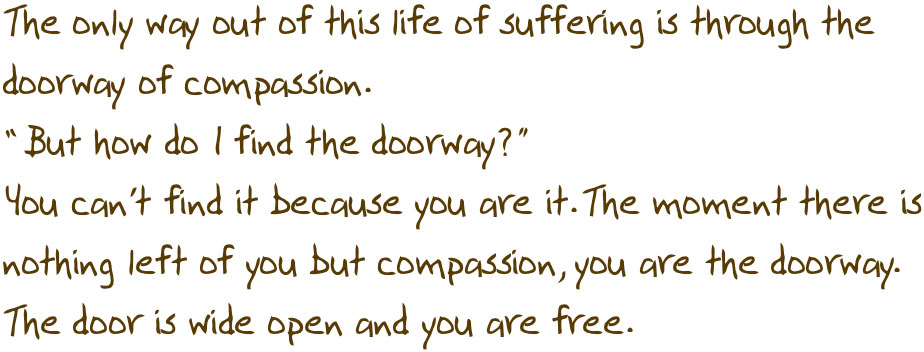
-- There Is Nothing Wrong with You
Gasshō,
ashwini
Monthly archive
June 2026 Musings
Audio of this month's Musings:
Download (right-click to download)
Subscribe to the audio version of Musings as you would any podcast. Add this feed URL to your podcast app:
https://www.livingcompassion.org/feed/musings/podcast-feed.rss